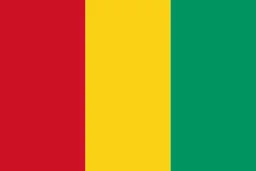
 Guinea: facts and statistics
The capital of Guinea is Conakry.
Guinea is a country in Western Africa.
Guinea has a population of 15,441,992 (2026, UN mid-year projection).
That is the 74th largest of the 195 countries ranked by the UN data.
The area of Guinea is 245,857 km² (as of 2025, mledoze/countries dataset).
Guinea has the 77th largest area of 195 ranked countries (as of 2025, mledoze/countries dataset).
The currency of Guinea is the Guinean franc (GNF).
The official language of Guinea is French.
Guinea became independent on October 2, 1958.
Facts
- Official name
- Republic of Guinea
- Capital
- Conakry
- Region
- Western Africa
- Form of government
- Presidential republic
- Independence
- October 2, 1958
- Currency
- Guinean franc (GNF)
- Official languages
- French
- Calling code
- +224
- Internet domain
- .gn
- Time zones
- Africa/Conakry
- Driving side
- right
- Highest point
- Mount Richard-Molard, 1,752 mWikidata
Land neighbours
Key statistics
Each indicator links to its own page with the full history and the world ranking.
People
| Indicator | Value | Year | Rank | Source |
|---|---|---|---|---|
| Population | 15,441,992 | 2026 | 74 of 195 | UN mid-year projection |
| Population density | 60.0 people per km² | 2024 | 126 of 193 | World Bank |
| Population growth | 2.31% | 2025 | 33 of 194 | World Bank |
| Urban population | 38.5% | 2025 | 155 of 194 | World Bank |
| Life expectancy | 60.9 years | 2024 | 187 of 194 | World Bank |
| Fertility rate | 4.13 births per woman | 2024 | 20 of 194 | World Bank |
| Median age | 18.0 years | 2023 | 174 of 195 | UN |
| Adult literacy | 39.6% | 2018 | 115 of 119 | World Bank |
| Internet users | 33.3% | 2024 | 161 of 184 | World Bank |
Economy
| Indicator | Value | Year | Rank | Source |
|---|---|---|---|---|
| GDP | $28.35 billion | 2025 | 115 of 190 | World Bank |
| GDP per capita | $1,877 | 2025 | 158 of 190 | World Bank |
| GDP per capita, PPP | 4,935 international dollars | 2025 | 153 of 186 | World Bank |
| GDP growth | 7.4% | 2025 | 16 of 189 | World Bank |
| Inflation | 3.6% | 2025 | 73 of 177 | World Bank |
| Unemployment | 5.2% | 2025 | 87 of 178 | World Bank |
| Human Development Index | 0.500 | 2023 | 177 of 191 | UNDP |
| Income inequality (Gini) | 29.6 | 2018 | 127 of 154 | World Bank |
Land
| Indicator | Value | Year | Rank | Source |
|---|---|---|---|---|
| Area | 245,857 km² | as of 2025 | 77 of 195 | mledoze/countries dataset |
| Forest area | 20.0% | 2024 | 121 of 193 | World Bank |
| Arable land | 24.7% | 2024 | 39 of 190 | World Bank |
| Coastline | 320 km | as of 2025 | 114 of 150 | CIA World Factbook |
| CO2 emissions per person | 0.30 tonnes | 2024 | 170 of 192 | Global Carbon Project |
Guinea through history
Guinea became independent on October 2, 1958.
In 1958, the year Guinea became independent, its population was 3,436,432 (UN mid-year estimate).
The nearest world map in the atlas to that year is 1960.
Map quizzes that include Guinea
Frequently asked questions
What is the capital of Guinea?
The capital of Guinea is Conakry.
What is the population of Guinea?
Guinea has a population of 15,441,992 (2026, UN mid-year projection).
What is the area of Guinea?
The area of Guinea is 245,857 km² (as of 2025, mledoze/countries dataset).
What currency does Guinea use?
The currency of Guinea is the Guinean franc (GNF).
What language is spoken in Guinea?
The official language of Guinea is French.
When did Guinea become independent?
Guinea became independent on October 2, 1958.
Sources and method
- UN - World Population Prospects 2024, Licence: CC BY 3.0 IGO
- World Bank - World Development Indicators, Licence: CC BY 4.0
- UNDP - Human Development Report, Licence: CC BY 3.0 IGO
- mledoze/countries (country profiles, area), Licence: ODbL 1.0
- CIA World Factbook (final snapshot), Licence: Public domain
- Global Carbon Project - Global Carbon Budget, Licence: CC BY 4.0
- Wikidata (highest points, city populations, driving side, names), Licence: CC0
- IANA Time Zone Database, Licence: Public domain
UN figures are from UN - World Population Prospects 2024, Medium variant, World Population Prospects 2024 (revision 1): Interim update, released 19 January 2026 (Togo replaced; all other locations as released 11 July 2024); downloaded 2026-11-24. They count people on 1 July of each year. Values up to 2023 are estimates; later values are projections.
World Bank figures are the latest annual value in the data (World Development Indicators). Where the two sources give a population for the same year and differ by more than 2%, the page says so.
The population rank is computed from the UN values for 2026 among the 195 independent states that have a value; territories and dependencies are not ranked.
A year given as "as of" is when the figure was read from the source, not the year it describes.
Last updated:
More about Guinea
- World ranking: Population
- World ranking: Population density
- World ranking: Population growth
- World ranking: Urban population
- World ranking: Life expectancy
- World ranking: Fertility rate
- World ranking: Median age
- World ranking: Adult literacy
- World ranking: Internet users
- World ranking: GDP
- World ranking: GDP per capita
- World ranking: GDP per capita, PPP
- World ranking: GDP growth
- World ranking: Inflation
- World ranking: Unemployment
- World ranking: Human Development Index
- World ranking: Income inequality (Gini)
- World ranking: Area
- World ranking: Forest area
- World ranking: Arable land
- World ranking: Coastline
- World ranking: CO2 emissions per person
Every year has a map
Drag a timeline across 2,500 years in the free Geographic History app - every province, ruler and battle, also offline.